Professional-Grade Gluten Free Flours | Vegan & Allergy Friendly | Australia-Wide Delivery


· By R2R Team
Thin‑Crust Gluten‑Free Pizza: Dough & Baking Tips
You can only imagine how hard it is to make a gluten free pizza crust at home. You bake something by a recipe, roll out the dough, fill it with toppings, and what comes out of the oven is a big spongy slab or a piece of cardboard that falls apart the first time it is picked up. It is annoying, more so when you require a proper pizza night without making any concessions.
Here's the good news: a truly crispy, thin-crust, gluten-free pizza is absolutely achievable, and it's far easier than you might think. The trick is in the correct gluten free pizza flour, understanding of the gluten-free doughs working the opposite way compared to the normal wheat-based ones and some clever tricks in baking, which makes a miracle.
What makes this approach even better? There's no yeast and no rise time required. It implies that you could prepare a homemade glute -free pizza within less than 30 minutes, starting with the dough preparation and emerging with a golden, crispy base with a pull.
This blog, founded on the trusted food items of Gluten Free World, guides you in everything you need to know, whether you are coeliac, gluten-sensitive, or just want to be gluten-free.
Baking Tips for Maximum Crispiness

Management of heat and technique is all that is required to achieve a crispy gluten free pizza crust. These four steps will make sure that you never have a wet bottom again.
Pre-heat Your Oven Properly
This is non-negotiable. Preheat your oven to 200°C in fan-forced mode, and do not take the pizza anywhere near the oven until it gets fully preheated. The first cause of a soft and disappointing base happens to be a cold or underheated oven.
It is the first burst of high temperature that causes the moisture in the dough to be expelled in a short time, resulting in that crispy bite on the bottom. A baking tray with a lot of weight or a pizza stone should be placed in the oven at the preheat stage; the outcome will make a significant difference.
Par-Bake the Base First
A very good gluten free baking tip for making pizza is to par-bake your crust and then add whatever you want on it. First of all, bake the bare dough for approximately 10 minutes. This forms the base structure, does not allow the base to get waterlogged after the addition of the sauce and toppings and aids in the formation of that crispy exterior. Adding too much sauce is one of the greatest errors that home bakers make.
Prevent a Soggy Crust
Toppings may also restore moisture even when the baking is par-baked. Some tips for making it crispy:
-
It does not need to be overloaded with the sauce; a very thin and smooth layer suffices.
-
Pat vegetables dry before placing them on the pizza.
-
In case fresh mozzarella is used, dry it with a paper towel first.
-
Avoid topping all the way to the very edge, so the rim can stay firm and crunchy.
Final Bake
After adding the toppings, place the pizza back into the oven, where it will be cooked for another 10-15 minutes. Watch the edges; you see a deep, golden colour on the crust. It must have a firm base, which will not flop due to lifting a slice.
Step-by-Step Guide: How to Bake Thin-Crust Gluten-Free Pizza

Now let's get practical. Here is the complete method, including the official Gluten Free World Pizza Base Recipe, along with everything you need to know about the dough itself.
The Gluten Free World Pizza Base Recipe
Serves: 2 | Time: 25 minutes | Nut Free
Ingredients:
-
225g Gluten Free World Pizza Flour.
-
Pinch of salt.
-
200 ml warm water.
-
1 tablespoon olive oil.
-
Toppings of your choice.
Method:
-
Pre-heat oven to 200°C (fan forced).
-
Place all ingredients into the bowl of a stand mixer. Using the hook attachment, combine at a low/medium speed for 5 minutes.
-
Transfer dough onto a lightly oiled 30 cm pizza tray.
-
Using your hands, spread the dough evenly over the tray.
-
Par-bake for 10 minutes.
-
Remove from the oven and add toppings.
-
Return to the oven for 10–15 minutes.
This recipe is simple, fast, and absolutely delicious.
Best Flour Blends for a Crispy Base
Finding a gluten free pizza flour mix that is not gluten-free is not an easy task. The secret to a fantastic thin crust gluten free pizza is utilising a flour that is specially engineered to work as pizza flour, one that resembles the elasticity and structure that gluten typically offers.
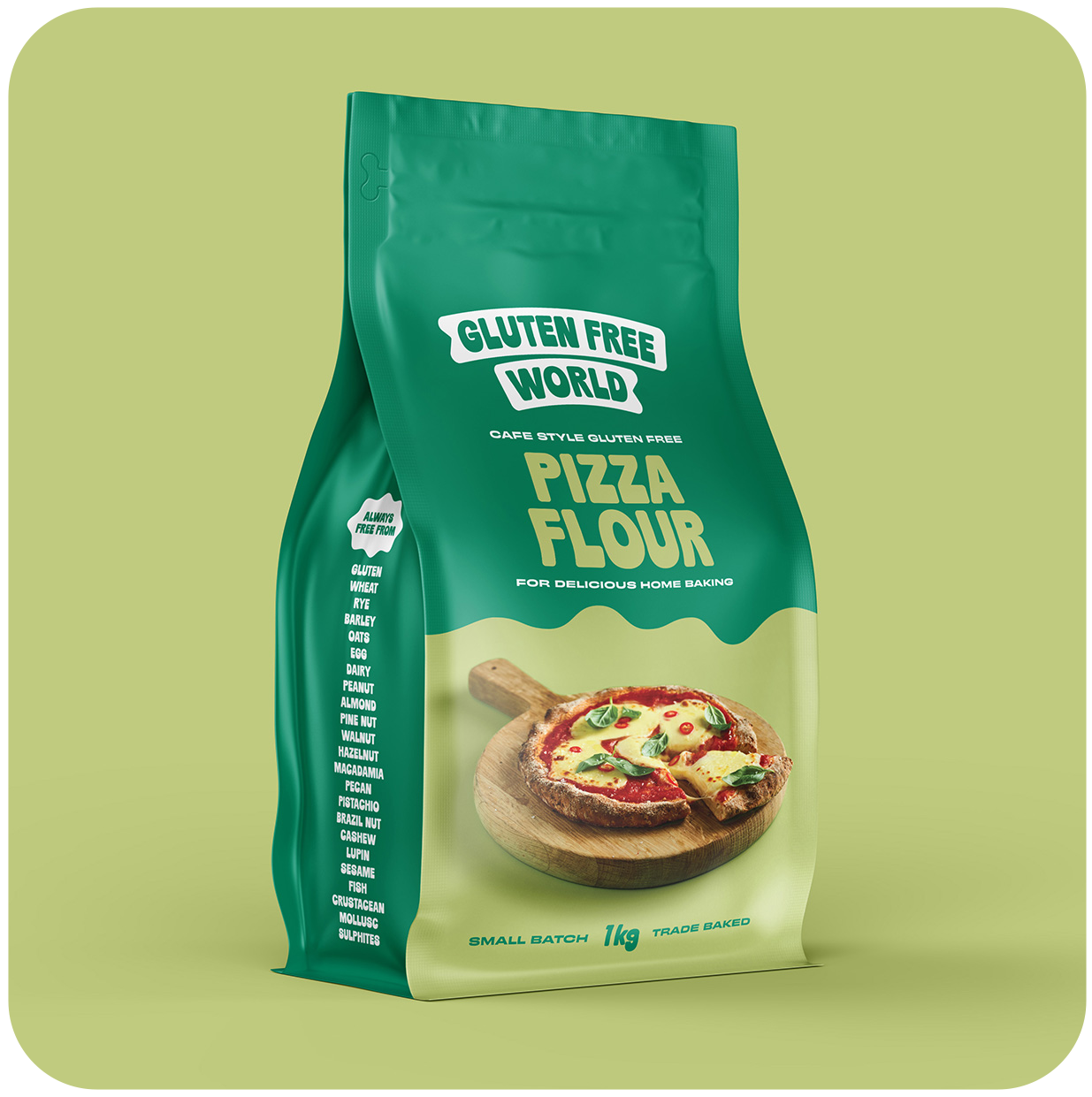
Our pizza flour is purpose-blended for exactly this result, giving you a dough that holds together, spreads beautifully, and bakes up crispy rather than gummy or dense. It is also certified by Coeliac Australia, Kosher Australia, and HACCP, so you can bake without any doubts.
Hydration Is Key
One of the most significant factors in no yeast gluten free pizza dough is getting the water ratio. Gluten-free dough, in contrast to wheat dough, uses starches and binding agents (instead of gluten) to maintain its structure, so it is more sensitive to the quantity of liquid employed.
In our recipe, the 200 ml of warm water is the optimal point; too much water will give you a wet dough that will not spread and will be impossible to bake, and too little water will give you too much of a wet dough. In case you have a too-thick dough, incorporate water one teaspoon at a time. In case it is too sloppy to spread, a touch more flour may be added.
Shaping the Dough
Since this is a no yeast gluten free pizza dough, it would not act as a normal yeasted dough would. It is no stretch; toss it. The lack of elasticity is actually beneficial for thin-crust pizza.
And to make a pizza, all you need to do is to pour the dough into a slightly oiled pizza tray and press it into it with your fingers (or a slightly oiled spatula) to stretch it into the edges. Strive to have the same uniformity of thickness, say 3-5 mm, to bake evenly. Wet the hands a little when the dough is adhering.
Prevent Bubbles
Gluten-free bases of pizzas tend to bubble and puff when baking. To avoid this, when you are moulding the dough on the tray, prick the surface everywhere with a fork, then par-bake. This enables the steam to escape evenly rather than accumulating below the lifting parts of the crust. It is just a little step, but that counts.
No Rise Required
The best thing about this recipe is one of the most significant, and this is that it is a no yeast gluten-free pizza dough, i.e., it means that there is no rise time at all. The dough proceeds directly from the mixer to the tray for the oven.
Partly this is what renders it perfect in a thin, crisp bottom: no air holes, no rising, merely a flat, level crust, which cooks solid and golden. This is a game-changer for anybody who has ever had difficulty with gluten-free yeast doughs in the past.
Reasons to Choose Gluten Free World for Your Pizza

In the case of homemade gluten-free pizza, what counts more than practically anything is the quality of your ingredients. Here's why Gluten Free World is the go-to choice for gluten-free bakers across Australia:
-
Purpose-built pizza flour: specifically formulated to give you a crispy, thin crust every time, not a generic all-purpose flour trying to do a job it wasn't designed for.
-
Certified and trusted: all the products are certified by Coeliac Australia, and thus, they are safe for those with coeliac disease. There is also a Kosher certification and an HACCP certification of products.
-
Easy to use: the recipes are simple, and there is no complex method involved. To achieve excellent results, you do not have to be a good baker.
-
Australian-made: Gluten Free World is Australian-made, where the products are produced considering the local kitchen and local tastes.
-
Full recipe support: from pizza bases to bread and cakes, Gluten Free World's recipe library gives you everything you need to make the most of their flours.
Whether you have just been diagnosed with coeliac disease or have been gluten-free baking for a long time, the presence of a reliable, high-quality pizza flour in your pantry to score that crispy base is a necessity.
Discover Our Full Gluten Free Product Range
Shop with confidence. See full product info, certifications, and the best Gluten Free Flours for your next bake.
Conclusion
Having a crispy and tasty thin crust gluten free pizza is no longer a far-fetched dream but a 25-minute reality. Combined with the appropriate gluten-free pizza flour, a mix-free technique, and a handful of gluten free baking tips (greetings, par-baking!), you can always emerge with a golden, firm-bodied pizza out of your oven that will be just as fine as anything ever served at a traditional pizzeria.
No yeast, no rising, no stress. Just outstanding pizza.
We would be glad to know what you will make. Visit our site and experience the entire collection of gluten-free flours, and order your next evening's pizza now. Contact us today if you have any questions related to pizza flour mix or recipe.
People Also Ask (FAQ)
Q. Why is my gluten-free pizza dough so sticky?
Gluten-free doughs are also stickier than doughs made with wheat, as they do not contain a gluten network to give structure and elasticity. This is completely normal! The secret is to fight with the stickiness; instead of that, the trick is to use oil on the hands and the pizza tray and then use a spatula, or greasy fingers, to press the dough instead of kneading it or rolling it like a regular dough.
Q. Do I need yeast for this recipe?
No, and that is one of the best things! The Gluten Free World Pizza Base recipe is a no yeast, no rise dough. It goes directly from the combining to the oven and does not waste time at the expense of the texture or flavour. It is an authentic shortcut that is really effective.
Q. Can I freeze the dough?
Yes! When you have mixed up and divided the dough, you can freeze it (pre-baked or par-baked) to use it later. When freezing raw, place it on the pizza tray wrapped in a lot of cling film and freeze flat. It can be prepared in the fridge overnight, then brought to room temperature and baked when it is ready to use. Baked bottoms are especially easy to freeze; just top and bake directly out of the freezer.
Q. Why is my dough so sticky and hard to handle?
No yeast gluten free pizza dough tends to become sticky when it is well hydrated, indicating that you have it when what you want to achieve is a good final texture. Instead of putting excess flour (which is likely to render the base too dry and crumbly), it is better to generously oil hands and tray, then smear the surface with a wet spatula. Moving fast and not being shy about doing it also works.
Q. How do I reheat leftover gluten-free pizza without it getting soggy?
Do not use the microwave; it will soften the base and make it chewable. Rather, warm your slices of pizza again in a dry frying pan over medium heat for 2-3 minutes, or put them back in the oven and warm them at 180°C and leave them in the oven for 5-8 minutes. Both are good at recrisping the base and are quite worth the few additional minutes.
